AI Compliance for Financial Institutions: The Complete Guide.
A practical guide for CCOs, CROs, and AI governance leads at regulated financial institutions navigating the EU AI Act, NIST AI RMF, and emerging US state regulations.
Financial institutions are deploying AI at an unprecedented pace. Credit scoring models, fraud detection engines, AML monitoring systems, customer chatbots, automated underwriting tools. According to a recent EY and MIT Technology Review study, more than 70% of banking firms are now using AI to some degree, with over half running active pilot projects.
But the governance infrastructure has not kept up. Most compliance teams are tracking AI systems in spreadsheets, if they are tracking them at all. Meanwhile, regulators in the EU, the US, and the UK are moving from principles to enforceable requirements, with the most consequential deadline landing on August 2, 2026, when the EU AI Act's high-risk obligations take full effect.
The question for compliance and risk leaders at banks, credit unions, lenders, insurers, and fintechs is no longer whether AI compliance matters. It is how to operationalize it before the deadlines arrive.
This guide breaks down what AI compliance means for regulated financial institutions specifically, the regulations you need to track, a practical framework for building your program, and the common pitfalls that trip up even well-resourced teams.
See how LucidTrust helps financial institutions operationalize AI compliance →
Free: The AI Governance Committee Playbook
AI Compliance
What AI Compliance Means for Banks, Lenders, and Fintechs
AI compliance is the practice of ensuring that every AI system your institution develops, deploys, or procures from a vendor meets the requirements of applicable laws, regulations, and internal governance standards.
That definition sounds straightforward. In practice, it is anything but.
Traditional compliance programs were built around static obligations: a regulation is published, you map it to controls, you evidence those controls during an audit, and you move on. AI compliance breaks that model. AI systems are dynamic. They learn, they drift, they get updated by vendors without notice. A model that was compliant at deployment can become non-compliant three months later if the underlying data shifts or the vendor retrains it.
For financial institutions, this challenge is compounded by the fact that AI compliance does not exist in a vacuum. It layers on top of an already dense regulatory stack. Prudential requirements under CRR and CRD, operational resilience obligations under DORA, payment services rules under PSD2, data protection under GDPR. AI-specific regulation does not replace any of this. It adds to it. And the regulators enforcing AI rules in financial services are the same ones that already supervise you: the EBA, ESMA, EIOPA in Europe, the FCA and PRA in the UK, the OCC, CFPB, and state regulators in the US.
High-Risk AI Use Cases in Financial Services
Credit scoring and creditworthiness assessment, loan approval and automated underwriting, insurance risk assessment and pricing, AML and fraud detection systems, and any form of automated decision-making that determines access to financial products or services. Under the EU AI Act, several of these are explicitly classified as high-risk, carrying the heaviest compliance obligations.
AI Compliance Regulations Financial Institutions Need to Know in 2026
The regulatory landscape for AI in financial services is moving on multiple fronts simultaneously. Here is what matters most right now.
EU AI Act
The EU AI Act is the most comprehensive AI-specific regulation in the world, and its most consequential provisions for financial institutions take effect on August 2, 2026.
The Act classifies AI systems into risk tiers. For financial services, the systems that matter most are those listed in Annex III as high-risk: AI used for evaluating creditworthiness or establishing credit scores (excluding fraud detection), and AI used for risk assessment and pricing in life and health insurance. If your institution deploys AI in any of these categories and serves EU customers, you are subject to the full suite of high-risk requirements.
Those requirements are substantial. Providers of high-risk AI systems must implement a documented risk management system that operates throughout the system's lifecycle. They must meet strict data governance standards for training, validation, and testing datasets, including documented provenance and quality controls. Technical documentation must be comprehensive enough for regulators to assess compliance. Systems must be designed for transparency and explainability, with human oversight mechanisms that allow authorized personnel to understand, monitor, and override outputs. Automatic logging must capture events throughout the system's operation, and deployers must retain those logs for a minimum of six months.
August 2, 2026
EU AI Act high-risk obligations become fully enforceable for Annex III systems, including credit scoring, insurance pricing, and automated financial decisioning.
Deployers, which is how most financial institutions will be classified when using vendor-provided AI, have their own set of obligations under Article 26. These include monitoring system performance in line with the provider's instructions, maintaining logs, reporting serious incidents to both the provider and the relevant market surveillance authority, and conducting fundamental rights impact assessments where applicable.
Enforcement will run through existing financial regulators. The EBA, ESMA, and EIOPA are designated as competent authorities for AI Act enforcement within financial services, meaning the same supervisors who conduct your prudential examinations will also assess your AI compliance.
One important development to watch: the European Commission's Digital Omnibus proposal, introduced in late 2025, may adjust certain timelines for high-risk obligations, linking them to the availability of harmonized standards. But the core obligations themselves remain unchanged, and the long-stop date for compliance is December 2027 at the latest. Waiting is not a viable strategy.
US Federal and State Regulation
The United States does not have a single federal AI law. What it has is a rapidly growing patchwork of federal guidance, state legislation, and enforcement actions that collectively create real compliance exposure.
On the federal side, the most significant recent development is the US Treasury's Financial Services AI Risk Management Framework, released in February 2026. Developed through collaboration between the Financial and Banking Information Infrastructure Committee and industry working groups, the FS AI RMF provides practical, scalable guidance for financial institutions at varying stages of AI adoption. It aligns closely with the NIST AI Risk Management Framework while tailoring it to financial services-specific risks and regulatory expectations. While voluntary, it signals clearly where regulators expect the industry to be heading.
At the state level, the Colorado AI Act took effect in February 2026, requiring businesses that deploy high-risk AI systems in consequential decisions, including financial services, lending, and insurance, to conduct impact assessments and implement risk management programs. California's training data transparency requirements became effective in January 2026. New York City's bias audit law mandates annual audits of automated employment decision tools. And multiple other states have proposed or enacted legislation targeting AI use in consumer finance and credit decisioning.
Existing enforcement mechanisms also apply. Federal agencies including the FTC, CFPB, OCC, and Federal Reserve have all signaled that discriminatory or deceptive AI outcomes will be assessed under current consumer protection and fair lending laws, including UDAP statutes. The absence of a unified federal AI law does not mean the absence of enforcement risk.
Global Frameworks and Standards
Beyond binding regulation, several voluntary frameworks are increasingly shaping how financial institutions structure their AI governance programs.
The NIST AI Risk Management Framework provides a structured approach to identifying, assessing, and mitigating AI risks. While it is not legally binding, it is referenced by regulators, auditors, and enterprise customers as a baseline for responsible AI governance. ISO 42001 establishes requirements for an AI management system, covering governance, risk, and the responsible development and use of AI. Certification against ISO 42001 is becoming a differentiator for institutions seeking to demonstrate maturity.
In the UK, the FCA has taken a principles-based approach, choosing not to introduce AI-specific rules but instead applying existing frameworks around consumer duty, operational resilience, and model risk management. However, the FCA has signaled that guidance on AI audit trails, explainability, and human-in-the-loop protocols is likely by the end of 2026. A Bank of England and FCA survey found that 75% of UK financial firms are already using AI, making this guidance highly anticipated.
AI Compliance
AI Compliance
Why AI Compliance Is Harder Than Traditional GRC
If you have run a compliance program before, you may be wondering why AI governance cannot simply be folded into your existing framework. In theory, the principles are the same. In practice, several factors make AI compliance fundamentally different.
Shadow AI. Business units and individual employees are adopting AI-powered tools, browser extensions, third-party plugins, generative AI platforms, without going through procurement or governance review. Your compliance program cannot cover systems it does not know about.
Vendor Opacity. Third-party providers are embedding AI into products financial institutions already use, often with limited disclosure about how models are trained, what data they process, or when they are updated. For deployers with regulatory obligations, this creates a transparency gap that traditional vendor risk assessments do not address.
Regulatory Fragmentation. The EU AI Act, US state laws, UK principles-based guidance, and sector-specific expectations from prudential regulators all overlap but do not perfectly align. Institutions operating across jurisdictions face conflicting or duplicative requirements that legacy GRC tools were not designed to reconcile.
Speed of Change. AI capabilities evolve faster than traditional compliance cycles can keep up. Annual risk assessments and periodic audits are insufficient when models can be retrained, fine-tuned, or replaced on a weekly basis.
Data Provenance. Tracing the origin and flow of data powering AI models is an ongoing challenge, especially with complex model supply chains involving multiple vendors and datasets.
Talent Gap. Compliance professionals typically lack AI and ML technical depth, while data scientists and engineers often have limited exposure to regulatory requirements. Bridging this gap requires new roles, new processes, and new tools.
From Spreadsheets to Systems: Operationalizing AI Compliance
Most financial institutions today are managing AI governance the way they managed early-stage compliance programs a decade ago: in spreadsheets, shared drives, email threads, and slide decks. It works when you have two or three AI systems to track. It breaks down quickly as adoption scales.
The shift from manual tracking to a purpose-built AI compliance platform is not about technology for its own sake. It is about building infrastructure that can keep pace with both the rate of AI adoption and the rate of regulatory change.
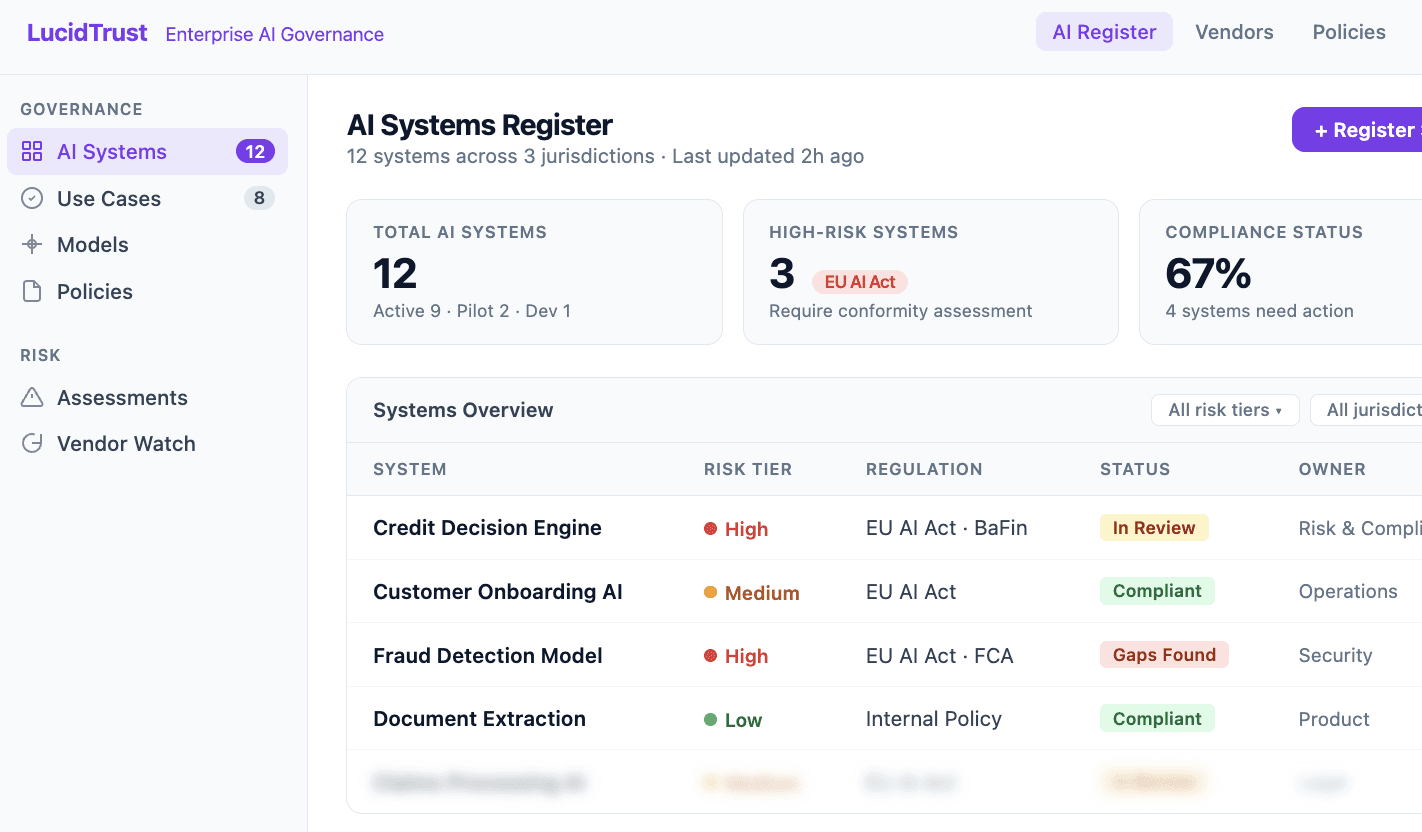
LucidTrust was built for exactly this problem. Purpose-built for regulated financial institutions, LucidTrust provides a single platform to inventory AI systems, track use cases and models, map obligations, manage risks and controls, monitor vendor AI, and maintain a trust center for stakeholder transparency. It is not a generic GRC tool with AI bolted on. It was designed from the ground up for the specific governance challenges that banks, credit unions, lenders, insurers, and fintechs face as AI adoption accelerates.
AI Compliance
Operationalizing AI Compliance
From Spreadsheets to Systems
AI Compliance
AI Compliance Timeline for Financial Institutions
The regulatory calendar is moving fast. Here are the dates that matter most.
February 2, 2025
EU AI Act prohibited practices and AI literacy obligations took effect. Organizations must have ceased any prohibited AI practices and begun ensuring staff have adequate AI literacy.
August 2, 2025
EU AI Act governance provisions and general-purpose AI model obligations became applicable. Providers of GPAI models must comply with transparency and documentation requirements.
January 1, 2026
California's Generative AI Training Data Transparency Act took effect, requiring developers to disclose information about datasets used to train AI systems.
February 2026
Colorado AI Act took effect, requiring impact assessments and risk management for high-risk AI in consequential decisions including financial services. The US Treasury released its Financial Services AI Risk Management Framework.
August 2, 2026
EU AI Act high-risk AI system obligations become fully enforceable for Annex III systems. This is the most consequential deadline for financial institutions using AI in credit scoring, insurance pricing, or automated financial decisioning. Conformity assessments must be completed, quality management systems operational, and EU database registration finalized.
Late 2026
UK FCA guidance on AI audit trails, explainability, and human-in-the-loop protocols expected.
August 2, 2027
EU AI Act obligations for regulated product AI systems under Annex I become fully enforceable.
The Window Is Closing
The distance between today and August 2, 2026 is measured in months, not years. For financial institutions that have not yet begun structuring their AI compliance programs, the time to start is now.
This is not just about avoiding fines, though the EU AI Act's penalties of up to 6% of global annual turnover make that a legitimate concern. It is about building the governance infrastructure that allows your institution to adopt AI confidently and at scale, with the transparency and controls that regulators, customers, and board members increasingly expect.
The institutions that treat AI compliance as a strategic capability rather than a regulatory burden will move faster, win more trust, and face fewer surprises when examiners come calling.