AI Governance & Compliance Roundup for Financial Services: February 2026
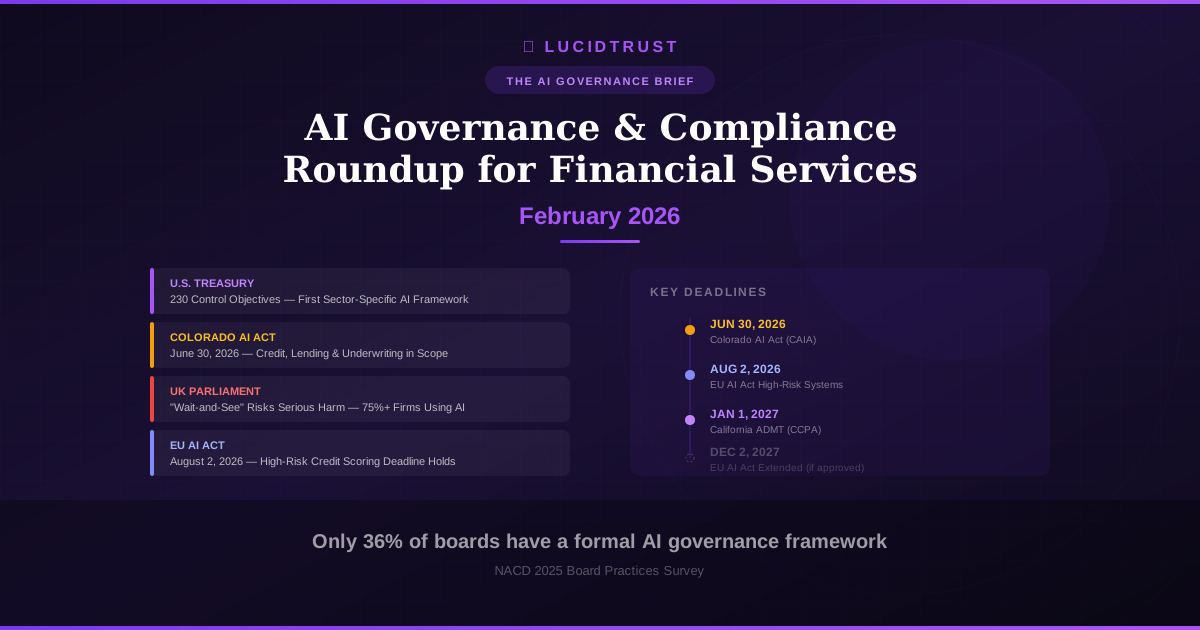
Treasury's 230-control-objective AI risk framework. Colorado's June deadline. UK Parliament warning. EU AI Act clock keeps ticking.
Date
Author
This roundup reflects the regulatory landscape as of February 2026. For current, continuously updated guidance, see What Is AI Governance?, What Is AI Compliance?, and SR 26-2 Replaced SR 11-7.
This Month at a Glance
U.S. Treasury releases a 230-control-objective AI risk framework — the first federal, sector-specific AI governance toolkit for financial services
Colorado AI Act takes effect June 30, 2026 — credit decisions, lending, and underwriting are explicitly in scope
UK Treasury Committee slams regulators' "wait-and-see" approach, says 75%+ of financial firms already use AI without adequate oversight
EU AI Act high-risk deadline holds at August 2, 2026 despite Digital Omnibus proposal
Only 36% of boards have a formal AI governance framework — Caremark liability exposure is real
FINRA flags GenAI as emerging risk; SEC shifts AI from fintech to operational risk category
Treasury's New 230-Control-Objective AI Risk Framework
On February 19, 2026, the U.S. Department of the Treasury released the most significant AI governance resource the financial services industry has seen: the Financial Services AI Risk Management Framework (FS AI RMF), alongside an AI Lexicon standardizing terminology across the sector. But here's what most coverage missed — these are the first two of six planned resources Treasury is rolling out through the end of February, covering governance and accountability, data integrity and security, fraud and digital identity, and operational resilience. (Read the Treasury press release)
What's Inside: 230 Control Objectives Mapped to Your AI Maturity
This isn't another high-level principles document. The FS AI RMF was developed in coordination with over 100 financial institutions, the Cyber Risk Institute (CRI), and the Financial Services Sector Coordinating Council (FSSCC). At its core is a Risk and Control Matrix containing 230 actionable control objectives spanning governance, data, model development, validation, monitoring, third-party risk, and consumer protection. The framework also includes an AI Adoption Stage Questionnaire that categorizes institutions into four maturity levels — Initial, Minimal, Evolving, and Embedded — so you're not implementing controls that don't apply to your current operations.
The accompanying toolkit includes a user guidebook and a control objective reference guide with illustrative examples of what good controls and effective evidence look like — the kind of artifacts that would satisfy an examiner.
Why This Matters for AI Vendor Risk Management
The FS AI RMF explicitly addresses vendor-provided AI and third-party risk. It's designed to integrate into existing enterprise risk architectures — complementing your operational resilience, cybersecurity, model risk management, and vendor oversight programs rather than creating parallel governance structures. Whether your institution builds AI internally or procures it from technology vendors, documented governance aligned to this framework is rapidly becoming the baseline that regulators and examiners will reference.
Why this matters: The FS AI RMF is being described by legal analysts as an "operational architecture standard" rather than a compliance checklist. State regulators look to guidance like this to understand emerging best practices — even though it's voluntary, institutions that proactively align to the 230 control objectives will be materially better positioned during examinations. This is the financial services equivalent of what NIST CSF was for cybersecurity.
Colorado AI Act: June 30, 2026 Deadline for Lending and Credit
The Colorado Artificial Intelligence Act (CAIA) — the most comprehensive state-level AI law in the U.S. — takes effect on June 30, 2026. Originally set for February 1, the deadline was pushed back during a special legislative session in August 2025 to give lawmakers more time to refine the framework. But the core obligations remain intact, and the financial services implications are significant.
Which Financial Services Activities Are Covered?
The CAIA covers any AI system that makes, or is a substantial factor in making, a "consequential decision" — and it explicitly includes financial and lending services. In practice, that means credit scoring models, underwriting algorithms, fraud detection systems, and collections tools are all potentially in scope if they substantially influence eligibility, pricing, terms, or other consequential determinations for Colorado consumers.
Compliance Requirements for Deployers and Developers
Deployers must implement a documented risk management program aligned to NIST AI RMF or ISO 42001, complete impact assessments before deployment, conduct annual bias audits, and provide consumer disclosures when AI contributes to decisions. Developers must provide deployer clients with the documentation needed for impact assessments, maintain a public use case inventory, and notify the Colorado Attorney General within 90 days of discovering algorithmic discrimination. Penalties run up to $20,000 per violation under the Colorado Consumer Protection Act.
What to watch: Colorado lawmakers may still amend provisions during the 2026 regular session, and Trump's December 2025 Executive Order on federal AI preemption adds uncertainty. But the compliance infrastructure — inventories, impact assessments, risk management programs — takes months to build regardless of how the final rules land. Financial institutions with a prudential regulator exemption should confirm their eligibility and gap analysis now.
UK Parliament: AI Regulation "Wait-and-See" Risks Serious Harm
The UK House of Commons Treasury Committee published a landmark report on January 20, 2026 that amounts to a wake-up call for the entire industry. The Committee's conclusion: the Bank of England, the FCA, and HM Treasury are exposing consumers and the financial system to "potentially serious harm" by taking a reactive approach to AI regulation in financial services.
75%+ of UK Financial Firms Already Use AI — Without Adequate Oversight
The report found that more than 75% of UK financial services firms are already using AI, with the largest adoption among insurers and international banks. AI is being used across core functions including credit assessments, insurance claims processing, and customer service automation. Yet the Committee found a troubling lack of accountability: senior managers within financial institutions struggled to assess AI risk, and the "lack of explainability" in AI models directly conflicts with the Senior Managers and Certification Regime's requirement that leaders demonstrate they understand and control the risks they're responsible for.
Key Recommendations for Regulators by End of 2026
The Committee made several pointed recommendations: the FCA must publish comprehensive, practical guidance on how existing consumer protection rules and the SM&CR regime apply to AI use by end of 2026. The Bank of England and FCA should introduce AI-specific stress testing to prepare for AI-driven market shocks. And HM Treasury must designate major AI and cloud providers as Critical Third Parties under the regime established in 2023 — a power that remains unused over a year later.
The signal: This report is significant because it comes from Parliament, not a think tank. For firms operating in or serving UK financial markets, the message is clear: the regulatory vacuum won't last. Firms that build AI governance infrastructure now will be ahead of whatever rules emerge. Meanwhile, in the U.S., FINRA's 2026 Oversight Report has flagged Generative AI as an emerging risk for the first time, and the SEC now treats AI as an operational risk category tied to cybersecurity and disclosures. Regulators globally are converging on the same expectations.
EU AI Act High-Risk Deadline Holds at August 2026
August 2, 2026 remains the general application date for the EU AI Act's high-risk AI system requirements. For financial institutions, the most critical classification is clear: AI systems used for credit scoring and creditworthiness assessments are classified as high-risk, triggering requirements around quality management systems, human oversight, technical documentation, and post-market monitoring.
Digital Omnibus Proposal and the Potential Deadline Extension
The European Commission's Digital Omnibus proposal (introduced November 2025) may push some high-risk deadlines to as late as December 2027 for certain systems — but the proposal still needs European Parliament approval and the timeline remains uncertain. The Digital Omnibus also proposes linking the effective date to the availability of harmonized standards and compliance support tools, creating a "moveable" start date with a hard backstop.
EBA Confirms AI Act Aligns with Existing Banking Regulation
In November 2025, the European Banking Authority published a factsheet confirming that existing EU banking regulations provide a strong foundation for AI Act compliance, with no significant contradictions between the AI Act and frameworks like DORA, CRR, and PSD2. However, AI-specific requirements must be layered on top. The EBA plans specific implementation activities in 2026-2027, including promoting supervisory cooperation between national competent authorities and market surveillance authorities.
Bottom line: The Digital Omnibus extension is extra preparation time, not a reason to delay. Financial institutions operating in or serving EU customers need to start mapping their AI systems to the Act's requirements now — especially around vendor-provided AI tools used in credit and lending decisions.
Key AI Compliance Deadlines: 2026–2027
June 30, 2026 — Colorado AI Act (CAIA) High-risk AI systems in financial services, lending, credit — impact assessments, risk management programs, bias audits, and consumer disclosures required.
August 2, 2026 — EU AI Act General Application High-risk AI system compliance for credit scoring and financial services. Full enforcement powers activated. GPAI model fines begin.
January 1, 2027 — California ADMT Regulations (CCPA) Full automated decision-making technology provisions — impacts financial services, employment, insurance, and legal services AI.
December 2, 2027 — EU AI Act Extended Deadline (if Digital Omnibus passes) Potential extended deadline for certain high-risk AI systems. Not yet law — depends on European Parliament approval.
Your One Action Item This Month
Every development we covered this month — Treasury's 230 control objectives, Colorado's June deadline, the UK Parliament warning, the EU AI Act — converges on the same starting point: knowing what AI you have and where it touches decisions that matter.
Ask your team this question:
"Can we produce a complete inventory of every AI system — including vendor-provided AI — that touches customer decisions, credit assessments, or compliance workflows?"
If the answer is no (or "kind of"), that's the exact gap regulators on both sides of the Atlantic are zeroing in on. And with Colorado's June 30 deadline now less than five months away, the time to start is now.
One more stat worth sharing with your board: according to the NACD's 2025 Board Practices Survey, only 36% of boards have implemented a formal AI governance framework, and just 6% have established AI-related management reporting metrics. With potential Caremark liability exposure for directors who fail to adequately oversee AI risk, this is a conversation that can't wait.
What We're Building at LucidTrust
This month we shipped our AI Assessment capability — it automatically scores your AI systems against regulatory requirements and surfaces compliance gaps so you can see exactly where you stand. And for institutions that want hands-on support, we're now offering our AI Governance Foundation Program: a focused 60-day engagement to stand up your complete AI governance framework, from inventory and risk scoring to board reporting and roadmap.
→ Book a 15-Minute Walkthrough → Learn About the 60-Day Program


