What Is AI Compliance? A Practical Guide for Financial Institutions
How banks and fintech companies operationalize AI governance, manage regulatory risk, and respond with defensible proof.
Date
Author
What Is AI Compliance? A Practical Guide for Financial Institutions
Artificial intelligence is no longer experimental in financial services. It's embedded in credit underwriting models, fraud detection engines, customer onboarding workflows, and third-party vendor platforms that touch every part of the business.
The question is no longer whether your organization uses AI.
The question is whether you can govern it, and prove that when someone asks
That is what AI compliance is. And for most financial institutions, it's the gap between "we have a policy" and "we can show you exactly what's running, who owns it, and how it's monitored."
What Is AI Compliance?
AI compliance is the structured oversight, documentation, risk management, and governance processes that ensure AI systems operate within regulatory, legal, and internal policy requirements.
For financial institutions and fintechs, this isn't abstract. It means being able to answer specific questions: Which AI systems are making credit decisions? What data did your fraud vendor use to train their model? Who approved the new AI feature your KYC provider shipped last month?
AI compliance intersects with supervisory frameworks you already know:
Model Risk Management (SR 11-7, OCC 2011-12)
Interagency Third-Party Risk Management guidance
Fair lending and UDAAP obligations
Data privacy regulations (GDPR, state-level)
Emerging AI-specific frameworks including the NIST AI Risk Management Framework and the EU AI Act
The common thread: regulators increasingly expect you to demonstrate structured oversight of AI risk — even where AI-specific mandates haven't fully landed yet.
AI Compliance vs. AI Governance: What's the Difference?
These terms get used interchangeably. They shouldn't be.
Term | What it means |
|---|---|
AI governance | The framework: policies, accountability structures, and oversight mechanisms that define how AI should be managed |
AI compliance | The proof: documentation, workflows, validation, monitoring, and reporting that demonstrate the governance framework is functioning |
Governance defines the rules. Compliance proves the rules are being followed. A policy stating "all high-risk AI systems require annual review" is governance. A record showing the review happened, who conducted it, what it found, and what actions followed, is compliance. Regulated institutions need both, and the gap between the two is where most organizations get stuck.
Why AI Compliance Matters Now
Regulators and examiners are already asking questions that most institutions struggle to answer:
What AI systems are in use across the organization?
Who owns each system?
How are models validated and monitored?
What third-party vendors are using AI on your behalf?
How are high-risk AI systems classified and controlled?
How does the board oversee AI risk?
In the US, federal banking regulators have signaled through existing model risk and third-party guidance that AI oversight is expected — even without a single "AI Compliance Act" on the books.
In Europe, the EU AI Act makes it explicit. AI systems used for creditworthiness assessment, fraud detection, and identity verification are classified as high-risk under Annex III, with conformity assessments, technical documentation, and ongoing monitoring obligations taking effect in August 2026. And under Article 26, deployers — not just providers — are accountable.
If you're a fintech with EU customers, or a bank with vendors that serve EU markets, this isn't theoretical.
Without structured AI compliance processes, these questions become difficult and risky to answer. With them, they become routine.
What AI Compliance Looks Like in Practice
For financial institutions and fintech companies, operational AI compliance breaks down into six areas:
1. AI System Inventory
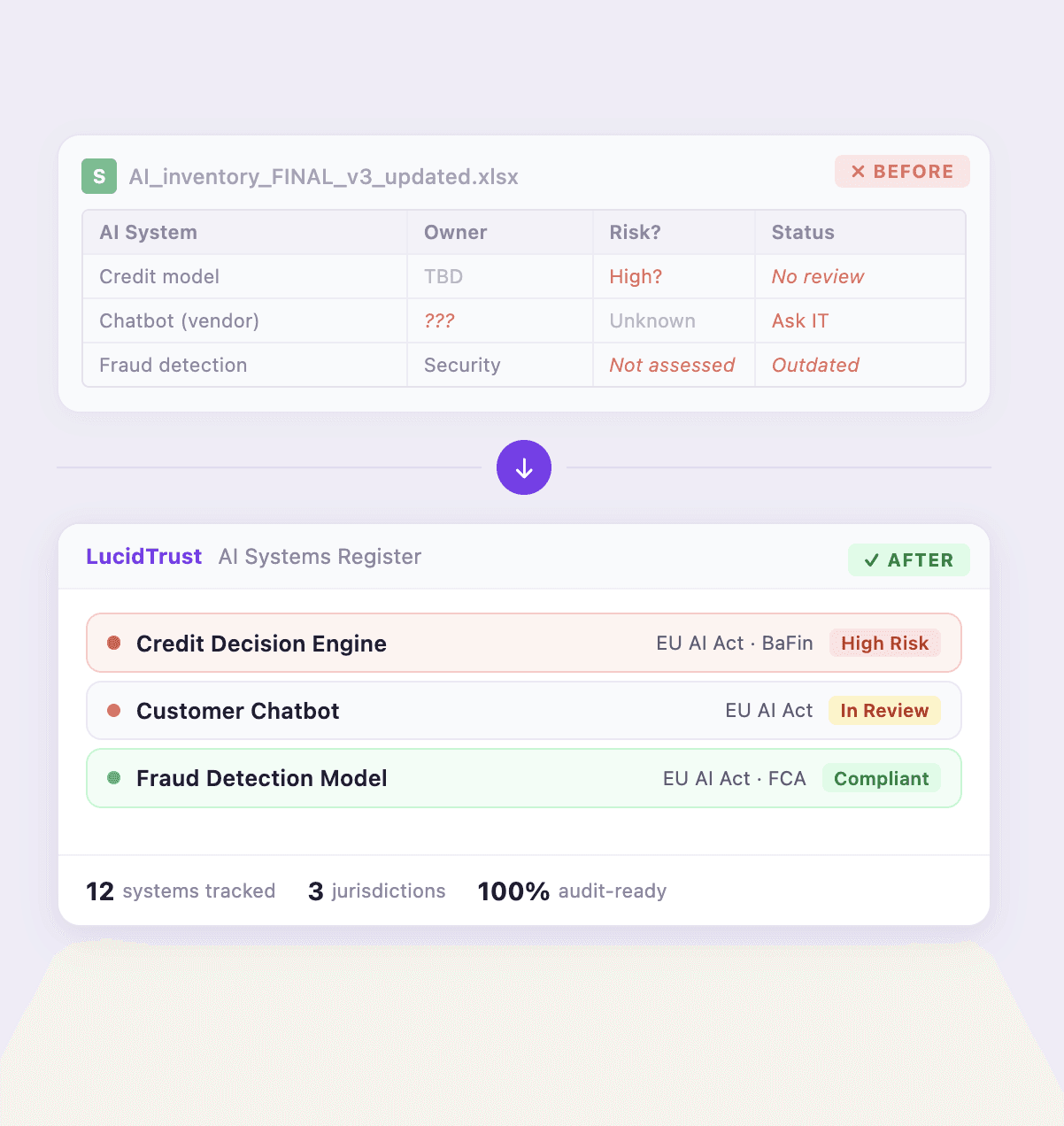
A centralized registry of every AI system, model, and use case across the organization. This includes business purpose, data inputs, model type, risk classification, ownership, and deployment status.
This sounds basic. In practice, most institutions can't produce this list. They know about the models their data science team built. They don't know about the AI features their CRM vendor shipped last quarter, or the machine learning running inside their document processing platform.
If you can't see your AI, you can't govern it.
2. Clear Ownership and Accountability
Every AI system needs a defined business owner, risk oversight involvement, model validation responsibility, and an ongoing monitoring cadence.
The challenge in financial services is cross-functional alignment. A credit underwriting model touches Product, Risk, Compliance, Legal, IT, and sometimes Privacy. AI compliance means defining who owns what — and making that visible, not buried in a policy document nobody reads.
3. Risk Classification
AI systems should be categorized based on regulatory impact, customer exposure, and business sensitivity.
For institutions with EU exposure, this aligns directly with EU AI Act risk tiers — where credit decisioning, fraud detection, and biometric identification are explicitly classified as high-risk. For US institutions, internal model risk tiers and customer impact levels serve the same function.
High-risk systems get enhanced oversight. Everything else gets proportionate governance. The point is having a framework — not treating every chatbot the same as your underwriting engine.
4. Model Validation and Monitoring
AI compliance extends beyond documentation. It includes pre-deployment validation, bias and fairness assessment, ongoing performance monitoring, change management tracking, and periodic review cycles.
For banks, this aligns closely with existing Model Risk Management programs. The gap is usually extending that same rigor to vendor-provided AI — which often gets a pass because "it came with the platform."
5. Third-Party AI Vendor Oversight
This is the blind spot. Most institutions rely on vendors that embed AI into their products — fraud detection, underwriting, KYC, document processing, customer service. Those vendors ship model updates, change training data, and add new AI features without notifying you.
AI compliance requires visibility into vendor AI usage, data handling practices, model transparency, and contractual safeguards. Traditional vendor questionnaires — built for security attestations like SOC 2 — don't cover AI-specific risks like model governance, bias testing, or training data provenance.
This is where most compliance programs have the widest gap.
6. Board-Level Reporting and Audit Trails
AI governance has to be explainable at the board level. Portfolio-level risk summaries, high-risk system tracking, incident reporting, evidence-ready documentation, and clear escalation workflows.
If regulators or auditors ask for proof of AI oversight, the answer should be a structured report — not a scramble through emails, spreadsheets, and Slack threads.
AI Compliance Evidence Checklist
When a regulator, auditor, or board member asks for proof of AI compliance, these are the artifacts that hold up:
A current AI system inventory, timestamped, covering internally built and vendor-provided systems
Documented ownership for each system: business owner, technical owner, monitoring responsibility
Risk classification for each system, along with the methodology behind the score
Validation records for each system: what was tested, when, and what was found
Vendor AI oversight records: what's being monitored, how often, and what triggers reassessment
An audit trail of approvals: who approved each system, on what basis, and when
A reporting format the board or examiner can actually use, produced on demand instead of reconstructed from emails and spreadsheets
An institution missing more than two or three of these is likely still at the "policy on paper" stage, with operational compliance still ahead of it.
Moving from Policy to Operational Compliance
Many organizations start their AI compliance journey with policy drafting. That's the right first step. But a policy document sitting in SharePoint is not compliance.
Operational AI compliance requires:
A living AI inventory that's actually maintained
Defined ownership and workflows that people follow
Risk classification logic that's applied consistently
Structured validation processes with documented outcomes
Ongoing monitoring — not just annual reviews
Evidence-ready reporting that can be produced on demand
The institutions that get this right aren't necessarily the ones with the biggest teams. They're the ones that move from static documents to structured governance systems — where compliance is built into how AI is managed, not bolted on after the fact.
The Bottom Line
AI compliance is not about slowing innovation. It's about making innovation defensible.
For financial institutions operating in regulated environments, that means knowing what AI is running across the organization, understanding its risk profile, assigning accountability, monitoring performance, governing third-party exposure, and being able to respond confidently when regulators, boards, or customers ask questions.
As AI adoption accelerates — and as regulatory expectations sharpen in both the US and EU — structured governance will become a competitive advantage, not just a checkbox.
The institutions that invest early will be better positioned to scale AI responsibly, win enterprise trust, and withstand regulatory scrutiny. The ones that wait will be playing catch-up against a deadline.
Frequently Asked Questions
Is AI compliance only relevant to institutions with EU exposure? No. US federal banking regulators expect AI oversight through existing model risk and third-party guidance even without an AI-specific mandate. EU exposure adds explicit, dated obligations on top of that baseline.
What's the fastest way to close the gap between having a policy and being able to prove compliance? Start with the inventory. Every other compliance artifact, risk classification, validation record, audit trail, depends on first knowing what AI systems exist.
Does AI compliance cover vendor-provided AI, or only systems we built ourselves? It covers both. Vendor-provided AI is usually the larger blind spot, since traditional vendor security reviews like SOC 2 don't assess model governance or training data provenance.
For a deeper look at what the EU AI Act specifically requires from financial institutions, read our guide: EU AI Act Compliance: What Financial Institutions Need to Know Before August 2026.
To understand why your existing vendor assessments may not be covering AI risk, see: 3 AI Vendor Risks Your SOC 2 Report Will Never Catch.
LucidTrust is the AI governance and compliance platform built for regulated financial institutions. We help compliance teams inventory AI systems, classify risk, manage vendor AI exposure, and stay audit-ready across every jurisdiction. Request a demo →


