
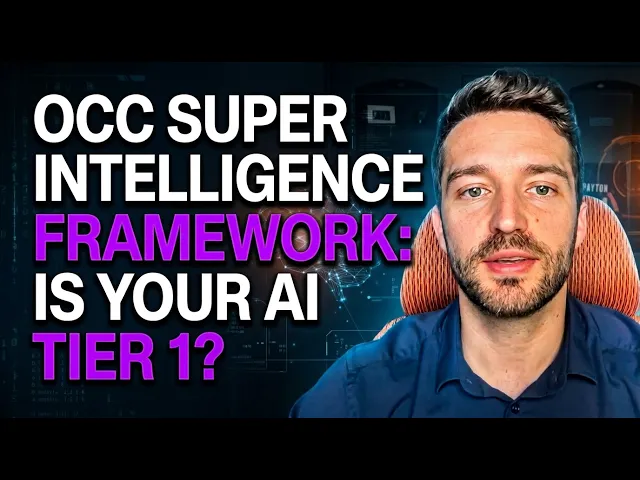
OCC Super Intelligence Framework: 4 AI Risk Tiers Explained (2026)
What banks need to know about the OCC's new supervisory framework, four illustrative AI risk tiers, and AI governance.
Date
Author
On November 4, 2026, the Office of the Comptroller of the Currency (OCC) issued Bulletin 2026-54, introducing a supervisory framework for evaluating banks' use of Super Intelligence (SI), the OCC's terminology for artificial intelligence.
The framework includes four illustrative AI risk tiers, ranging from Low to Critical, and addresses generative AI, autonomous AI agents, and their use across banking activities.
The central takeaway: AI risk depends less on how sophisticated a system is and more on what it's authorized to do, the potential consequences of failure, and the degree of human oversight.
Importantly, this framework is an examiner resource. It does not establish new regulatory requirements or supervisory expectations for banks.
Watch: OCC Super Intelligence Framework Explained
In this short video, LucidTrust breaks down the OCC's four illustrative risk tiers, explains what could place a banking AI use case in Tier 1: Critical, and shares five practical questions for AI governance committees.
Watch for the executive overview, then continue reading for a deeper examination of the framework and its implications for AI governance in banking.
Key Takeaways from OCC Bulletin 2026-54
The OCC's supervisory framework highlights several important considerations:
An examiner resource, not a new rule. The framework supports supervisory judgment without establishing new expectations or enforceable standards for banks.
AI is not a separate risk category. AI-related risks are evaluated within existing categories, including operational, compliance, and credit risk.
Consequences matter more than sophistication. An AI agent authorized to move money can present greater risk than a more sophisticated system limited to drafting documents.
Four illustrative risk tiers. The OCC provides Critical, High, Moderate, and Low profiles based on factors including autonomy, reversibility, and potential impact.
Vendor changes can change risk. New AI functionality or model changes introduced by third parties may warrant additional monitoring or reassessment.
An AI agent can be running but wrong. Operational resilience involves detecting and containing harmful actions, not simply recovering from system outages.
What Is the OCC Super Intelligence Framework?
The OCC's Super Intelligence Supervisory Framework is designed to help examiners evaluate how banks use AI in normal business activities.
The framework addresses applications including credit decisioning, payments, fraud detection, customer service, operations, risk management, and market activities.
It contains 16 components grouped into six pillars, an illustrative risk-tiering methodology, and a technical glossary.
The framework focuses particularly on generative and agentic AI, while traditional non-generative models remain subject to applicable model risk management principles.
The OCC also describes the framework as a living document that may evolve as AI technology, use cases, and supervisory understanding mature.
Why Does the OCC Call AI "Super Intelligence"?
The OCC uses the term Super Intelligence to encompass technologies previously described as artificial intelligence, along with their advancing capabilities.
The terminology follows Executive Order 14434, issued October 2, 2026.
In this context, Super Intelligence does not refer exclusively to hypothetical AI systems that exceed human intelligence. It broadly encompasses AI technologies and systems.
Does the OCC Framework Create New Requirements for Banks?
No.
The OCC explicitly states that the framework does not establish new supervisory expectations, enforceable standards, or prescriptive requirements.
Banks are not expected to use the document to assess their own SI use or risk management.
Rather, the framework is intended to help examiners tailor supervisory work according to the nature, materiality, and potential consequences of a bank's AI use cases.
The OCC also emphasizes proportionality, taking into account each institution's size, complexity, and risk profile.
For example, a community bank using AI for internal document summarization presents different considerations from an institution deploying autonomous payment agents.
That distinction matters because the framework emphasizes risk-based supervisory judgment rather than a uniform control model.
What Are the OCC's Four Illustrative AI Risk Tiers?
Section 3.2 of the framework presents four illustrative composite risk tiers.
These classifications consider potential consequences, autonomy, reversibility, human involvement, and customer or financial impact.
Risk Tier | Illustrative Profile | Example Use Cases |
|---|---|---|
Tier 1: Critical | Direct action, limited reversibility, high potential impact, autonomous or partially autonomous | Autonomous payment agents, real-time credit decisioning, fraud-hold release, market access |
Tier 2: High | Direct action or high-weight decision support, human-on-the-loop, moderate-to-high impact | AI-assisted underwriting, AML alert disposition, agent-initiated customer communications |
Tier 3: Moderate | Decision support requiring human approval, limited data sensitivity, reversible outcomes | Credit memo summarization, agent-assisted research |
Tier 4: Low | No direct action or customer/financial data exposure, fully human-controlled | Internal productivity tools, general employee Q&A |
Source: OCC Supervisory Framework on Bank Use of Super Intelligence, §3.2. Classifications and examples are illustrative, not mandatory.
Why Tier 1: Critical Matters
Consider an autonomous payment agent.
Unlike a system that simply recommends a payment for human approval, an autonomous agent may be authorized to initiate a transaction.
If something goes wrong, the consequences could include financial loss, customer harm, or transactions that are difficult to reverse.
The OCC specifically illustrates a fully autonomous, customer-facing payment agent as Tier 1, regardless of how well it performs in testing.
This demonstrates an important distinction:
Strong AI performance does not automatically eliminate the risks created by autonomy, delegated authority, and potentially irreversible actions.
Why the Same Technology Can Present Different Risks
The framework also illustrates how the context of AI use matters.
General code assistance appears among the Tier 4 examples.
But code assistance involving changes to internal code or data access appears among the Tier 2 examples.
The distinction is not necessarily the underlying model.
It is what the AI system is permitted to influence or execute, the degree of human oversight, and the consequences if something goes wrong.
What Are the Six Pillars of the OCC Framework?
The OCC groups its 16 framework components into six overarching pillars.
Pillar | Central Question |
|---|---|
Purpose | What is the AI system permitted to do? |
Risk | What are the consequences if it fails? |
Control | What prevents unauthorized or unsafe actions? |
Oversight | Who monitors the system, and who is accountable? |
Resilience | Can the bank detect, contain, recover from, and remediate failures? |
Assurance | What evidence demonstrates that controls continue to operate effectively? |
These pillars connect AI-specific considerations with established governance, model risk management, compliance, cybersecurity, and operational-risk practices.
One especially important consideration is defined purpose and permitted use.
The framework discusses documenting what an AI system is designed to do, what data and systems it may access, and what actions it is authorized to take.
It also introduces scope drift: situations where an AI system operates outside its approved purpose.
An action outside the authorized scope may represent a control failure even when the outcome appears reasonable.
Why AI Is Not a Separate Risk Category
The OCC clarifies that examiners should not treat Super Intelligence as a distinct risk category.
AI can instead introduce, amplify, or modify risks that banks already manage.
For example:
AI-supported lending decisions can affect credit risk and consumer compliance.
Autonomous payment agents can create operational, cybersecurity, and fraud exposure.
Vendor-provided AI tools can introduce third-party, privacy, and information-security risks.
The framework also clarifies that banks are not required to establish a separate SI risk appetite.
That does not mean AI-specific characteristics should be ignored. The framework identifies considerations that may help banks and examiners understand risks within existing categories.
Human-in-the-Loop vs. Human-on-the-Loop AI
Human oversight is a major consideration throughout the framework.
Two approaches are particularly important.
Human-in-the-loop (HITL) means a person reviews and approves an AI output or action before it is used or executed.
Human-on-the-loop (HOTL) means the AI system operates independently while a qualified person actively monitors its behavior and has the authority and practical ability to intervene.
The distinction matters because merely assigning a human reviewer does not guarantee meaningful oversight.
The OCC discusses considerations including reviewer expertise, decision-making authority, monitoring capacity, override capabilities, and escalation procedures.
For higher-impact or autonomous AI use cases, those considerations may become especially important.
Why AI Vendor Changes Deserve Attention
Many banks use AI capabilities provided by third-party vendors rather than developing the technology internally.
The OCC identifies several considerations associated with this reliance.
Vendors may introduce new AI features, change underlying models, or modify functionality within products that banks already use.
Those changes can potentially affect system behavior, data handling, performance, or risk exposure.
The framework discusses the possibility of banks seeking notification and transparency from vendors, reassessing relationships, or retesting systems when material changes occur.
For bank AI governance teams, an important practical question is:
Would your institution know if a vendor changed the AI model supporting a critical business process?
This is particularly relevant when AI capabilities are embedded in software products rather than deployed as standalone AI applications.
An AI Agent Can Be Running but Wrong
One of the framework's most important operational-resilience concepts is that an AI system can remain available while behaving incorrectly.
Traditional technology resilience often focuses on outages, system failures, and business continuity.
Autonomous AI introduces another concern.
An AI agent could remain fully operational while executing inappropriate actions, making incorrect decisions, or operating outside its approved boundaries.
The OCC discusses possible safeguards including:
Ongoing monitoring and observability
Controls that detect inappropriate agent behavior
Limits on transaction rates and system permissions
Human intervention, suspension, and escalation
Circuit breakers and kill switches
Recovery, remediation, and continuity arrangements
The underlying lesson is that system availability does not necessarily mean system behavior is acceptable.
For AI governance, knowing whether a system is running may be insufficient. Understanding what it is doing, and whether it remains within approved boundaries, can be just as important.
Five AI Governance Questions Bank Leaders Should Consider
The OCC framework does not require banks to adopt a particular AI governance checklist.
However, its risk-based concepts provide a useful foundation for internal discussions.
Here are five questions LucidTrust suggests bank AI governance committees consider.
1. Do We Know Every AI Use Case, Including Vendor Features?
Does the institution maintain visibility into AI applications, agents, and capabilities embedded in third-party systems?
A centralized inventory can help establish ownership, purpose, deployment status, and accountability.
2. Which AI Use Cases Can Act Autonomously?
Understanding what AI systems can do independently is essential to evaluating their potential consequences.
Are systems limited to recommendations, or can they execute transactions, modify records, or interact with customers?
Have material use cases been assessed according to autonomy, potential harm, reversibility, and human oversight?
3. Would We Know If a Vendor Changed Its AI Model?
Does the institution have visibility into significant changes in third-party AI functionality?
How are vendor updates identified, evaluated, and documented?
4. Are AI Agents Staying Within Their Approved Purpose?
Are the permitted activities, permissions, data access, and decision boundaries of AI agents clearly defined?
How does the institution identify potential scope drift or activity outside approved parameters?
5. Could We Reconstruct a Material AI Decision?
Could the institution produce meaningful evidence about an AI system's inputs, outputs, actions, approvals, and relevant changes?
The OCC's framework discusses documentation and auditability that may support reconstructing material outputs or actions, even when an AI model cannot produce a traditional rule-based rationale.
These questions are LucidTrust's suggested discussion points, not OCC-mandated requirements.
What Does This Mean for AI Governance in Banking?
The OCC framework reinforces a useful distinction:
Knowing what an AI system is capable of doing is not the same as knowing what it is authorized to do—or what it is actually doing.
As banks adopt increasingly autonomous AI, effective governance may require greater visibility into system purpose, permissions, third-party changes, human oversight, and operational behavior.
At LucidTrust, we believe effective AI governance begins with a simple principle:
You can't govern what you can't see.
The goal is not merely to maintain an inventory of AI systems, but to support meaningful accountability and evidence-based oversight as those systems evolve.
Frequently Asked Questions
Is the OCC Super Intelligence Framework a new regulation?
No. The OCC explicitly states that the document is an examiner resource and does not establish new regulatory requirements, supervisory expectations, or enforceable standards for banks.
What does Super Intelligence mean in the OCC framework?
The OCC uses Super Intelligence to encompass technologies previously described as artificial intelligence, including generative and agentic AI.
What are the four OCC AI risk tiers?
The framework describes four illustrative tiers: Tier 1 Critical, Tier 2 High, Tier 3 Moderate, and Tier 4 Low. The classifications consider the potential consequences, autonomy, reversibility, and other characteristics of AI use cases.
Is an autonomous payment agent considered Tier 1?
The OCC includes autonomous payment agents among its illustrative Tier 1 Critical use cases. The framework specifically explains that a fully autonomous, customer-facing payment agent can sit at Tier 1 regardless of testing performance.
Does the OCC require banks to establish a separate AI risk appetite?
No. The framework clarifies that banks are not required to define a separate SI risk appetite.
Does the framework apply to community banks?
The framework may be used by OCC examiners in assessing supervised banks, with examinations tailored to each institution's size, complexity, risk profile, and AI use cases.
When was OCC Bulletin 2026-54 issued?
November 4, 2026.
Official Sources
OCC Bulletin 2026-54 — Super Intelligence: Supervisory Framework
OCC Supervisory Framework on Bank Use of Super Intelligence — Full PDF
Disclaimer: This article is provided for educational and informational purposes and does not constitute legal, regulatory, or compliance advice. The OCC framework is an examiner resource, not a new set of requirements for banks. LucidTrust's governance questions are independent commentary and are not OCC requirements. LucidTrust is not affiliated with or endorsed by the OCC.


