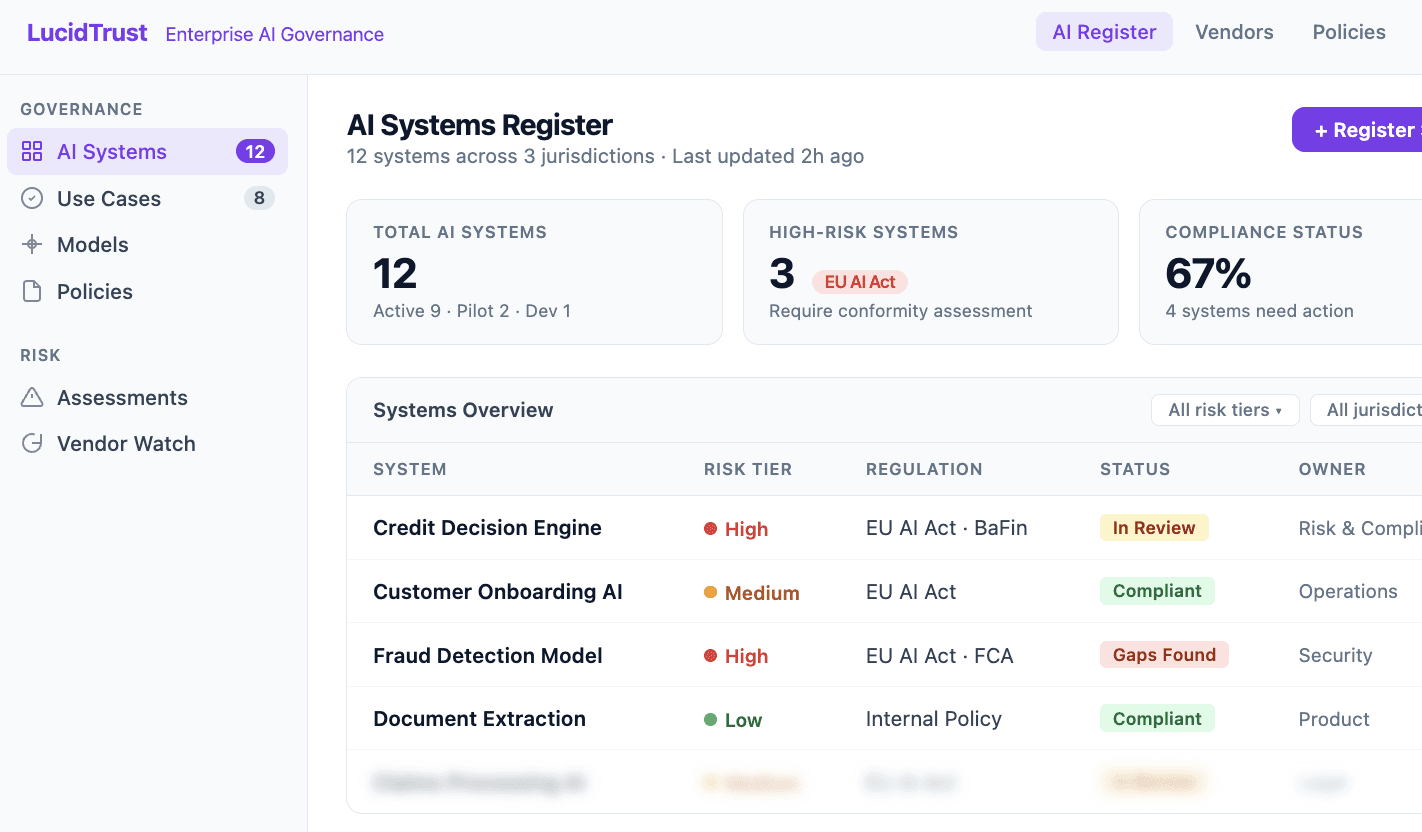
LucidTrust AI Use Case Governance Software

LucidTrust gives governance teams a structured way to evaluate AI use cases across the business. Teams can capture business purpose, data sensitivity, customer impact, automation level, jurisdiction, model or vendor dependency, ownership, approval status, and monitoring requirements.
This helps organizations apply consistent review standards while giving business teams a clear path to responsible AI adoption.
Structured intake
Capture the business purpose, user population, system or vendor, model, data categories, affected workflow, and intended outcome.
Risk classification
Assess each use case based on customer impact, decisioning role, data sensitivity, jurisdiction, automation level, and business criticality.
Review routing
Send use cases to the right stakeholders across risk, compliance, legal, privacy, security, IT, data science, and business teams.
Approval conditions
Document approvals, rejections, exceptions, mitigations, usage limits, monitoring requirements, and reassessment dates.
Ongoing monitoring
Track whether approved use cases change over time due to new users, new data, new models, vendor changes, or expanded scope.
Evidence trail
Maintain a record of every submission, review, decision, exception, and follow-up action.
Use AI Vendor Due Diligence to support new vendor review, AI-enabled software assessment, procurement intake, security and privacy review, third-party risk management, and governance committee decisions.
1
Give business teams a clear path.
Make it easier for teams to submit AI use cases and understand what happens next.
2
Apply consistent review standards.
Reduce ad hoc decisions by applying risk-based criteria across the organization.
3
Prioritize high-risk activity.
Focus governance resources on use cases with the greatest customer, regulatory, data, or operational impact.
4
Preserve decision history.
Show who reviewed the use case, what was decided, why it was approved, and what controls apply.