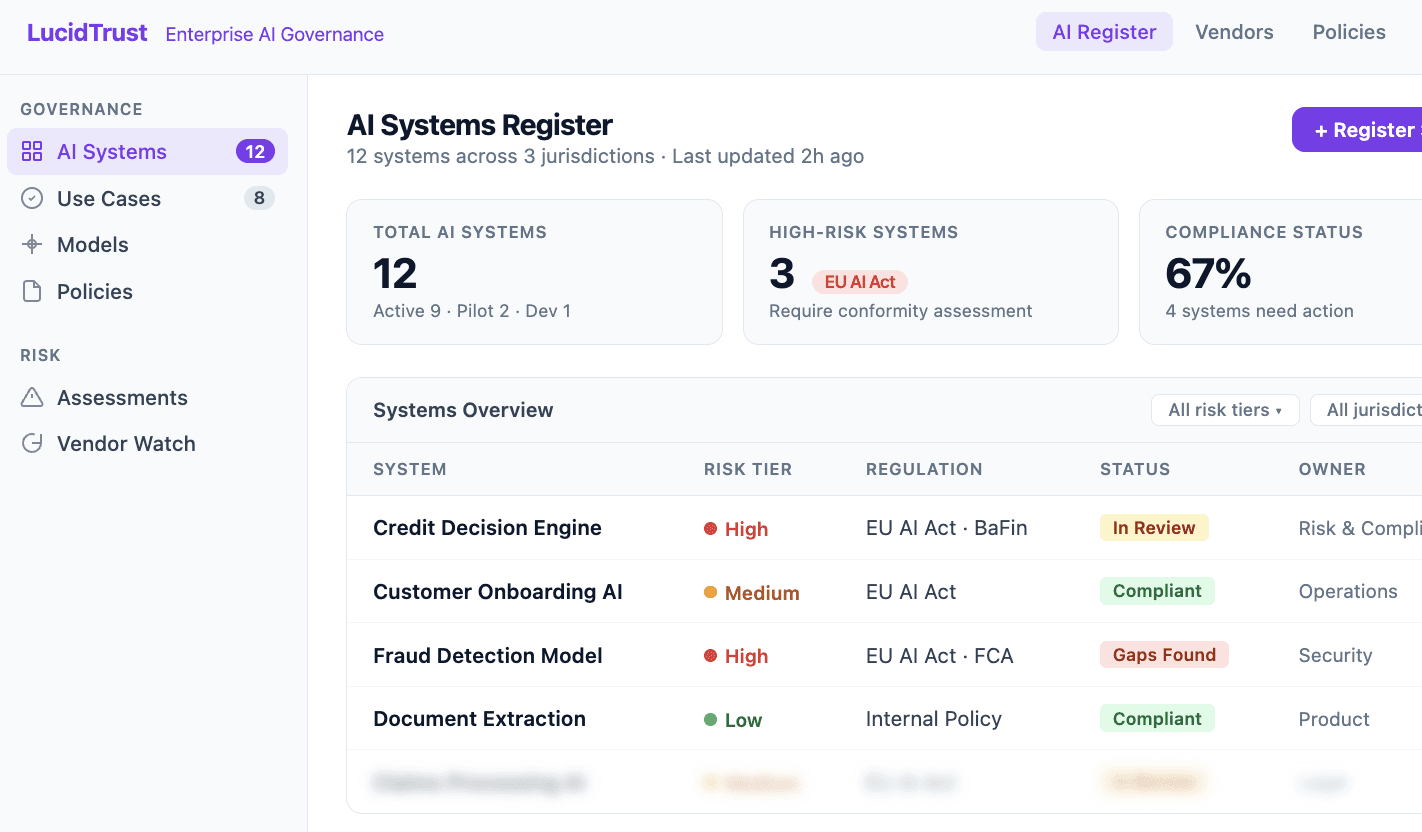
LucidTrust AI Governance Workflows Software

LucidTrust helps teams move AI requests, vendor changes, model updates, agent reviews, exceptions, and reassessments through a consistent governance workflow.
Each workflow can bring together the right stakeholders, review criteria, supporting documentation, approval requirements, and evidence trail so teams can make decisions faster and preserve the record behind them.
AI intake
Capture the business purpose, vendor, model, agent, use case, data usage, owner, affected users, and intended outcome.
Risk classification
Use configurable criteria to classify requests by use case, data sensitivity, autonomy level, jurisdiction, customer impact, and review requirements.
Cross-functional review
Route reviews to the right stakeholders across risk, compliance, legal, security, privacy, IT, procurement, data science, AI, and business teams.
Approvals and exceptions
Document approvals, conditions, mitigations, exceptions, rejected requests, required controls, and follow-up actions.
Reassessment and monitoring
Track required reassessments, vendor changes, model updates, agent scope changes, control updates, and ongoing accountability.
Audit trail
Maintain a complete history of who reviewed what, when, why, and with what supporting evidence.
Use AI Governance Workflows to manage the moments when AI oversight needs a clear path forward.
New AI tool requests
Review new AI-enabled tools with the right owner, business purpose, data context, and approval path.
Vendor AI feature changes
Route material vendor updates when new AI capabilities, model changes, or data policy shifts affect approved use.
AI use case reviews
Evaluate business-led AI use cases consistently based on risk, data sensitivity, customer impact, and required controls.
Agent or model expansion
Reassess approved agents or models when permissions, scope, dependencies, users, or business context changes.
Policy exceptions
Document exception requests, approval conditions, mitigations, owners, and follow-up requirements.
Required reassessments
Track periodic reviews and updated approvals for AI systems, vendors, agents, models, and use cases.
Capture the context behind each request, review, approval, exception, reassessment, and follow-up so governance activity is easy to trace and ready to report.
1
Reduce ad hoc review.
Give teams a defined path for intake, routing, approval, exception handling, and reassessment.
2
Keep context attached.
Maintain the link between the AI record, risk attributes, reviewers, decisions, and supporting documentation.
3
Make ownership visible.
Show who needs to review, who approved, what conditions apply, and what follow-up is still open.
4
Create evidence as work happens.
Capture the history behind governance activity so teams can support reporting, audits, exams, and customer diligence.