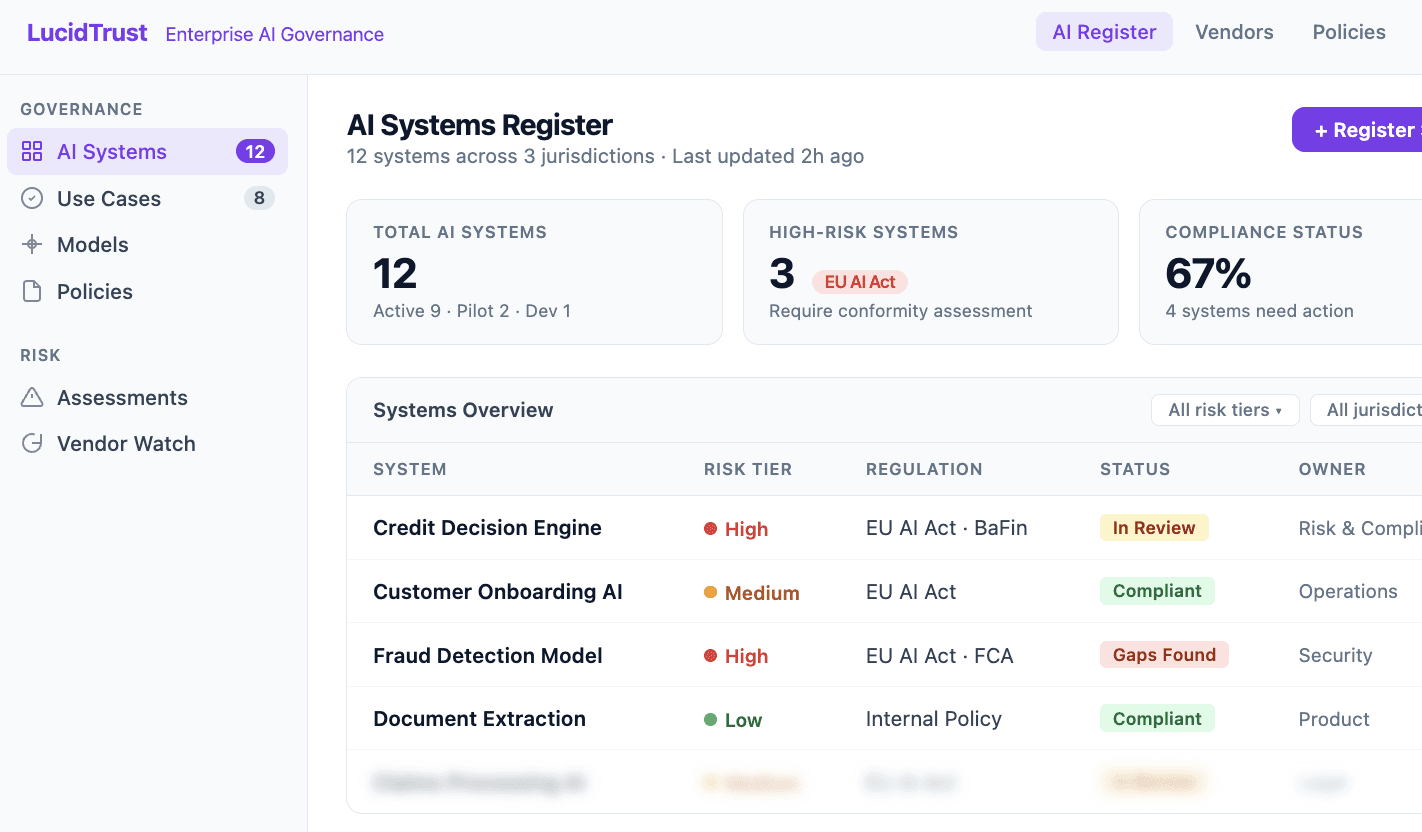
LucidTrust AI Agent Governance Software

AI agents introduce new governance considerations because they can interact with systems, retrieve data, trigger workflows, make recommendations, draft outputs, or take action with varying degrees of autonomy.
LucidTrust helps teams document each agent’s purpose, permissions, data access, action scope, ownership, controls, human oversight, escalation path, and monitoring requirements.
Agent inventory
Maintain a register of approved and proposed AI agents, including owner, purpose, business process, system access, and operational status.
Permission and access mapping
Document what systems, data, tools, APIs, and workflows each agent can access or affect.
Action scope
Define whether the agent can recommend, draft, execute, escalate, approve, modify records, communicate externally, or trigger downstream processes.
Human oversight
Capture approval requirements, human-in-the-loop controls, escalation paths, and stop conditions.
Risk classification
Assess agents based on autonomy level, data sensitivity, business impact, customer exposure, and control environment.
Audit trail
Preserve records of review, approval, oversight controls, changes, exceptions, and follow-up actions.
Track each agent’s purpose, permissions, data access, action scope, controls, and human oversight before autonomy creates exposure.
1
Understand what agents can do.
Document actions, permissions, systems, data access, and operating constraints.
2
Apply controls based on autonomy.
Route higher-autonomy agents through the deeper review and oversight they require.
3
Track scope over time.
Monitor when agents gain new permissions, connect to new systems, or expand beyond their original use case.
4
Support leadership and audit questions.
Show how agents are approved, controlled, monitored, and reassessed over time.