LucidTrust for Financial Services
Financial institutions run AI across lending, deposits, payments, fraud detection, marketing, servicing, and internal operations. Each business line adopts AI at its own pace, usually through vendor platforms. The result is an AI footprint that spans multiple regulators, multiple risk owners, and multiple systems of record, with no single place that reflects what actually exists.
AI risk spans every business line in the institution.
Model risk management
Credit, fraud, and pricing models fall under existing model risk frameworks, but many institutions have no equivalent process for AI models embedded in vendor platforms or built outside the model risk team.
Third-party and vendor risk
Core banking, payments, and servicing vendors add AI features inside existing contracts, often without a new vendor review or contract amendment.
Business-line adoption
Marketing, operations, and customer service teams adopt AI tools independent of enterprise risk, creating usage that sits outside the formal inventory.
Multi-regulator exposure
A single institution may report to prudential regulators, securities regulators, and state authorities, each asking different questions about AI oversight.
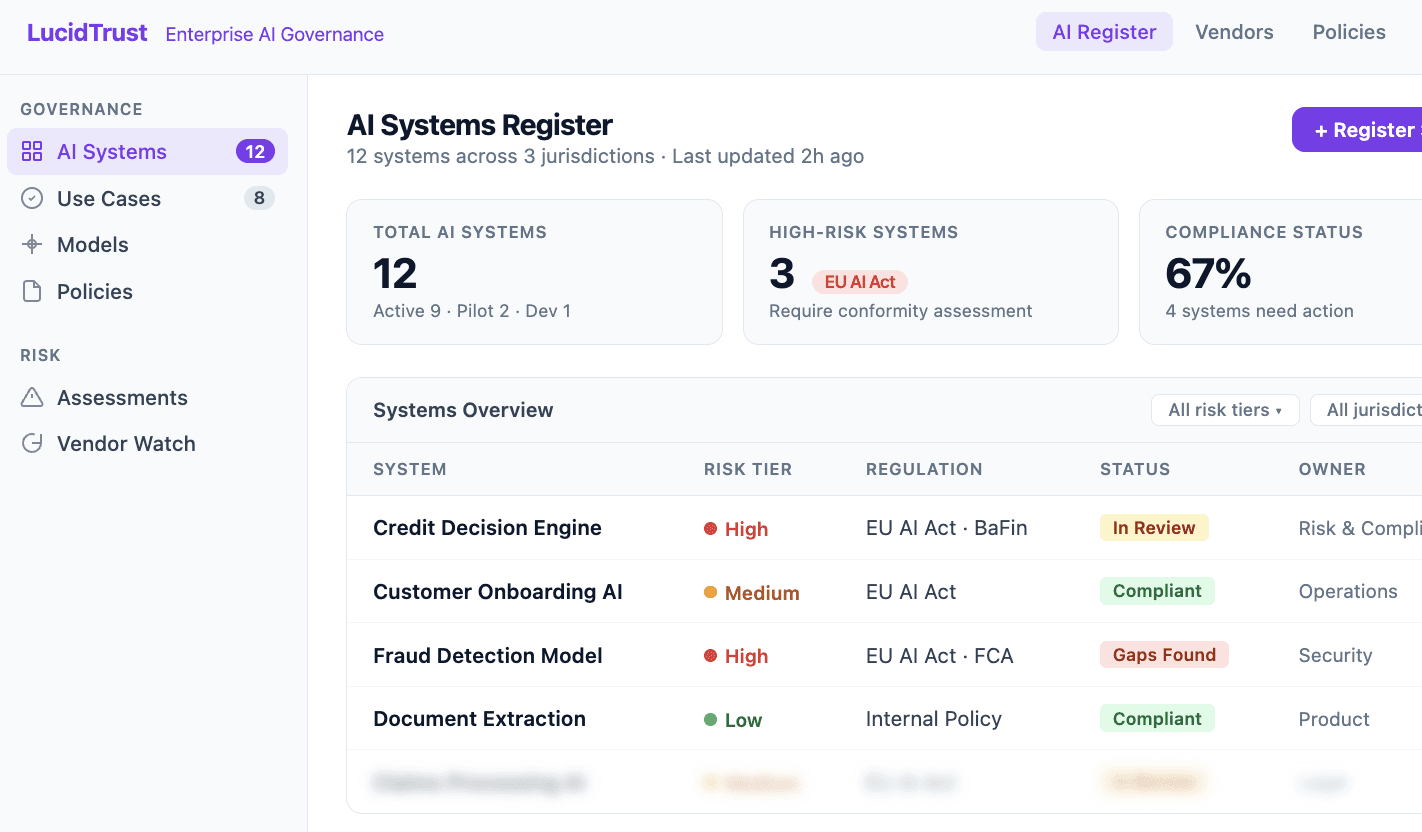
Consolidate the enterprise AI inventory
Bring model risk, vendor risk, and business-line AI use into a single register shared across departments.
Monitor vendor AI change across the institution
Track when core banking, payments, servicing, and marketing vendors introduce new AI capabilities.
Apply consistent review criteria
Route AI requests through the same intake and risk classification regardless of which business line submitted them.
Preserve evidence across regulators
Generate reporting formatted for the specific questions prudential, securities, and state examiners ask.
Give the board one view
Show AI adoption, risk exposure, and governance maturity across the full institution in a single report.