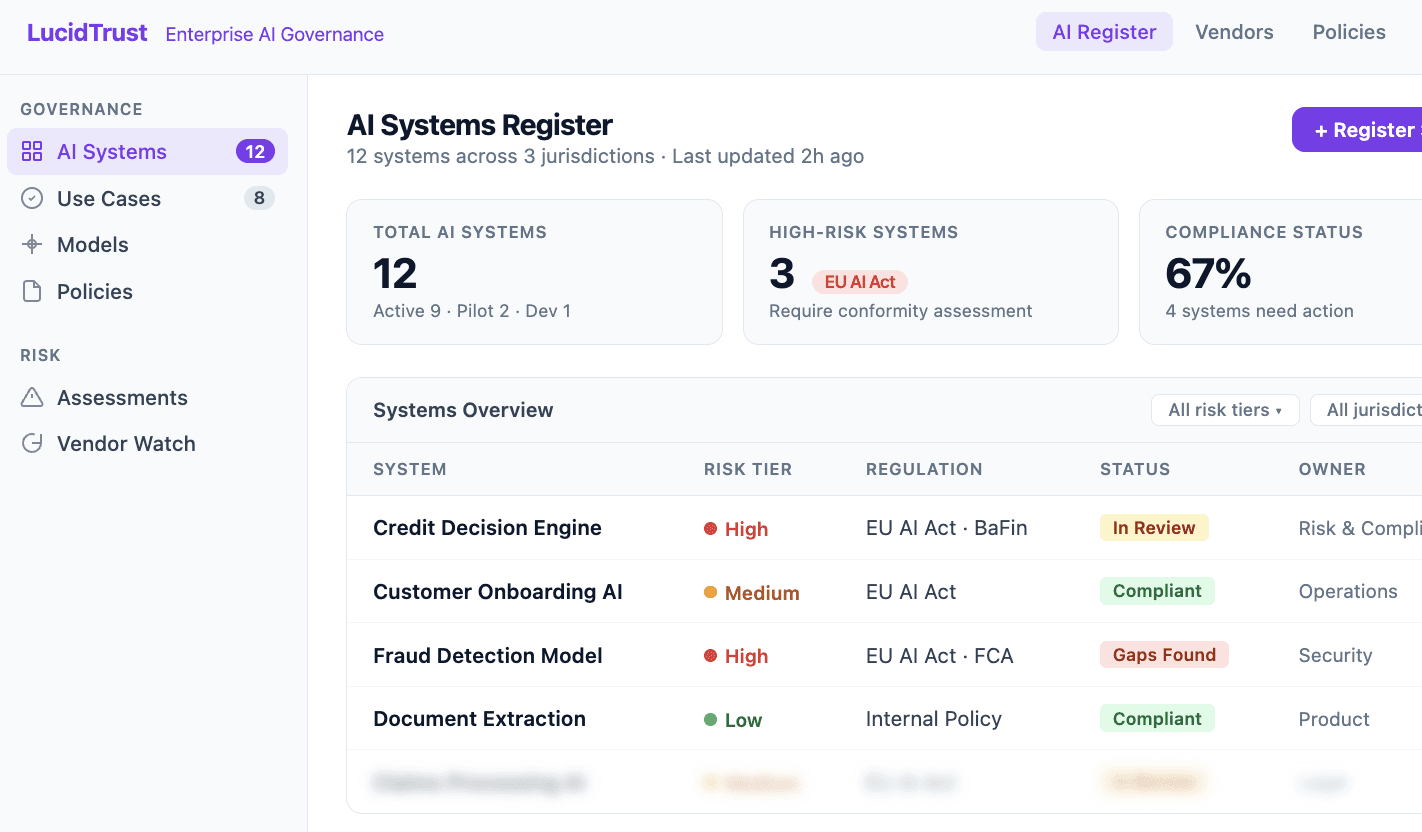
LucidTrust AI Model Inventory & Risk Software

LucidTrust helps organizations track internal models, third-party models, embedded vendor models, open-source models, and AI services in one governance context.
Each model record can connect technical details to business use, ownership, vendor dependency, risk attributes, review status, validation activity, monitoring requirements, and audit evidence. This gives teams a practical way to manage model oversight as part of the broader AI governance program.
Model inventory
Maintain structured records for internal models, third-party models, vendor models, AI services, and embedded model capabilities.
Ownership and purpose
Capture business owner, technical owner, intended use, affected workflow, user population, and business criticality.
Risk attributes
Document data inputs, output type, automation level, customer impact, explainability needs, jurisdiction, and risk tier.
Validation and review status
Track model review, validation, approval status, limitations, conditions, exceptions, and reassessment requirements.
Vendor and dependency context
Connect models to vendors, systems, use cases, agents, policies, and downstream workflows.
Monitoring requirements
Define the controls and review cadence required for model changes, performance concerns, drift signals, vendor updates, and expanded usage.
Evidence trail
Preserve decisions, approvals, validation records, monitoring actions, exceptions, and review history.
Track internal, vendor, and embedded models alongside use cases, ownership, dependencies, controls, monitoring requirements, and evidence.
1
Create a complete view of model exposure.
See internal, third-party, and embedded models in one governance context.
2
Connect technical records to business risk.
Understand not just what the model is, but where it is used, what it affects, and what oversight it requires.
3
Coordinate reviews across teams.
Bring model risk, compliance, legal, security, privacy, data science, vendor risk, and business owners into a consistent process.
4
Produce defensible evidence.
Show how models are inventoried, reviewed, approved, monitored, and reassessed over time.